


Seeds of change: restoring forests and creating income in Brazil
In Central Brazil, seed collector Dinaura Zago Sobrinho often spends hours walking through dense forests, gathering seeds. Through a collaboration between De Heus and the Black Jaguar Foundation, she is helping restore one of South America’s most important ecosystems. This project is not only rebuilding biodiversity, but also empowering people in rural communities both financially and socially.

As one of the world’s major food producers, Brazil is demonstrating a strong commitment to sustainability, one that depends on collaboration between government, private initiatives and rural communities. One such effort aims to restore degraded land across the Araguaia Biodiversity Corridor, the vital region connecting the Amazon rainforest and the Cerrado savanna, with a goal of restoring more than one million hectares and planting around two billion trees.
The NGO leading this is the Black Jaguar Foundation (BJF). De Heus has supported BJF since 2021, its annual contribution funding large-scale tree nurseries, fire-prevention training and native-tree planting. So far, around two million trees have been planted and nearly a thousand hectares of forest have been restored across an area that will span up to 2,600 kilometres in length and 40 kilometres in width.
Aligned with strategic goals
The partnership goes beyond one-off support. De Heus contributes by providing financial support for nurseries, training and tree planting activities. Since 2021, this long-term collaboration reflects a shared commitment to sustainable agriculture.
A central part of BJF’s approach is working with landowners to restore degraded areas on their farms, helping them combine agricultural production with environmental improvement.
For De Heus, this partnership supports its broader sustainability ambitions and contributes to its commitment to nourishing future generations.
“They see changes in the forest, weather and rivers and feel inspired to take action to protect their crops, families and the environment.”

Laís D’Isep dos Santos
Community Connector at BJF
Nurseries for young trees
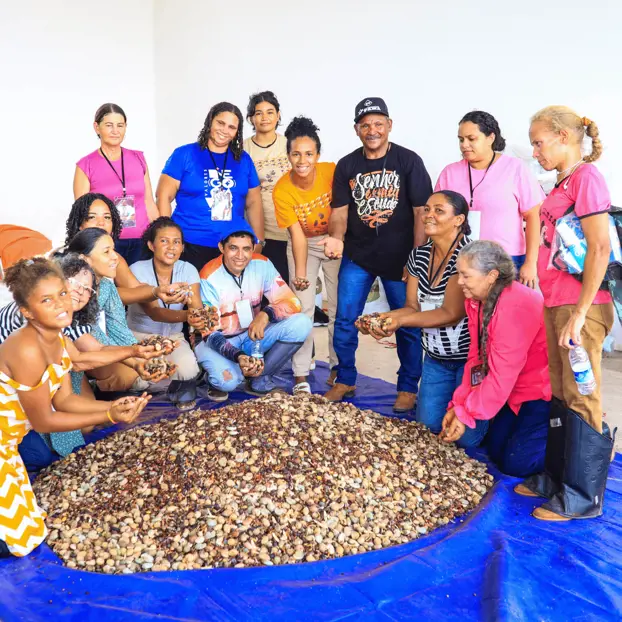
Before trees can be planted, they must first be grown in BJF’s nursery in Santana do Araguaia, Pará. And that requires seeds. “It isn’t possible to buy seeds of all 85 native species the project needs. Seeing an opportunity to solve this while involving local communities, BJF set up Ressemear, the Araguaia Seed Network,” says Laís D’Isep dos Santos, Community Connector at BJF. She recruits and trains collectors to gather, clean and store seeds to BJF’s quality standards.
Local knowledge enhances value
“We currently have 150 collectors, around 60% of them women,” says Laís. “All come from smallholder families, so they already have valuable local ecological knowledge. Seed collecting is an extra source of household income, especially welcome now that increasing mechanisation and trade liberalisation are putting pressure on small-scale farmers.”
Creating life-changing income opportunities
Over nine tons of native seeds have been collected since 2021, generating around BRL 450,000 (approximately €76,800) for the collectors. For most, spare-time collecting adds roughly one extra month’s income a year; for a few it is now full-time. Dinaura is among the top collectors, with 397 kg from 35 species since late 2022. “This has changed my life completely,” she says. “We can pay our bills and still save a little, the income even paid for my husband’s surgery.” “There’s also an empowering effect,” adds Laís.
“This has changed my life completely. We can pay our bills and still save a little, the income even paid for my husband’s surgery.”

Dinaura Zago Sobrinho
Seed Collector
Personally making a difference
Dinaura values the income, but the work is personally rewarding too. “I’ve always loved nature, but now I understand the ecosystem better. There’s nothing better than a standing forest; my heart hurts when I see someone cut down a tree.” Sustainability motivates many collectors, Laís adds: “They see changes in the forest, weather and rivers and feel inspired to take action to protect their crops, families and the environment.”


Scaling impact for the future
Dinaura has become a strong ambassador, recruiting many new members locally. “Her group is the biggest and fastest-growing, and the whole network grows every year through word of mouth. We now have enough collectors to meet BJF’s current needs, so our focus is shifting to professionalizing the network,” says Laís. Therefore Laís is developing a Guide to Good Practice to protect quality, and giving collectors more autonomy in administrative and business roles. “We are very grateful for the support from De Heus, which helps us scale this impact.”
Accelerating the transformation
Laís expects the seed-collecting network Ressemear to stay involved with BJF and the Araguaia Biodiversity Corridor for at least the next decade. “We already supply seeds to other restoration projects, and by formalizing Ressemear as a legal entity, it will let us apply for more funding and attract new NGO partners,” she explains.
This growth will increase demand for seeds, allowing the network to involve more collectors and create additional income opportunities for local communities.
By supporting these initiatives, De Heus contributes to strengthening livelihoods while enabling long-term restoration efforts.


